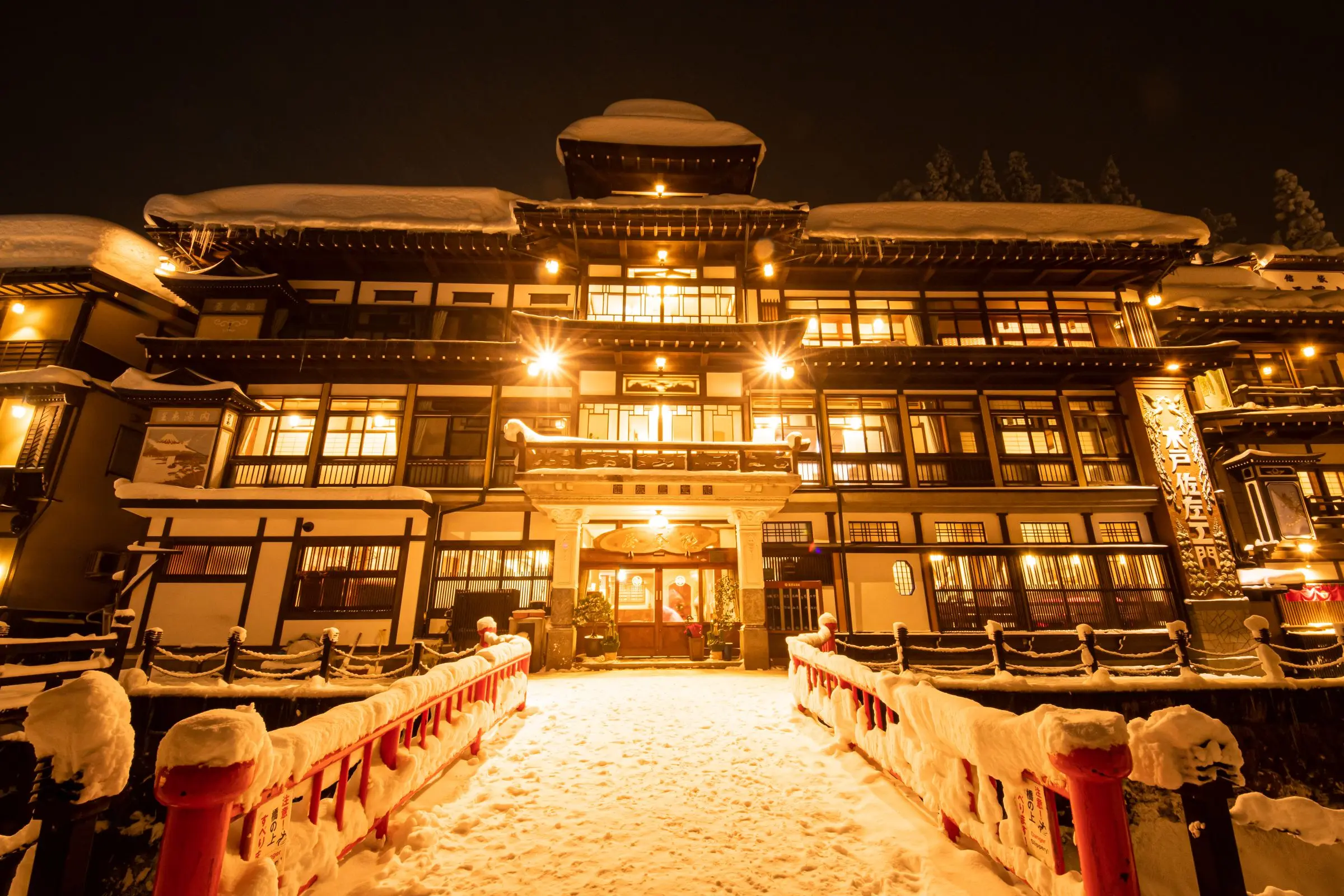
There is a moment that every visitor to Ginzan Onsen eventually describes the same way. You step off the bus at dusk, you walk the ten minutes to the pedestrian-only onsen street along the Ginzan River, and you see it: the row of Taisho-era multi-storey wooden ryokans rising from both banks, their facades glowing warm against the dark mountain gorge, the gas lamps on the street burning orange-yellow, steam rising from the river below. And somewhere in the back of your visual memory, a frame from Spirited Away assembles itself without being asked for. This is the building that made that happen. Notoya Ryokan stands at the center of the Ginzan Onsen riverfront, its four-storey wooden facade of layered balconies and stucco relief panels illuminated each evening, designated as a registered tangible cultural property of Japan, and named in the Wikipedia article on Spirited Away as one of the inspirations for the Aburaya bathhouse.
The ryokan was established in Meiji 25 — 1892 — and its current Taisho-era wooden building, constructed during the building boom that transformed Ginzan Onsen's riverside into its present form, carries more than a century of uninterrupted hospitality in the same structure. It is a member of the Nihon Hiyu wo Mamoru Kai — the Society for the Preservation of Japan's Secret Hot Springs — a membership that signals a commitment to certain standards of spring quality and traditional ryokan practice. It has 15 guest rooms across its main and annex buildings. Its cave bath, used continuously since the ryokan's founding as the original hot spring source, can be reserved for exclusive private use. The Ginzan River runs past the entrance, audible from every room on the river-facing side, its sound exactly as Spirited Away requires it to be: present, constant, belonging to a world operating on its own schedule.
The Town: Ginzan Onsen and Its Hundred-Year Street
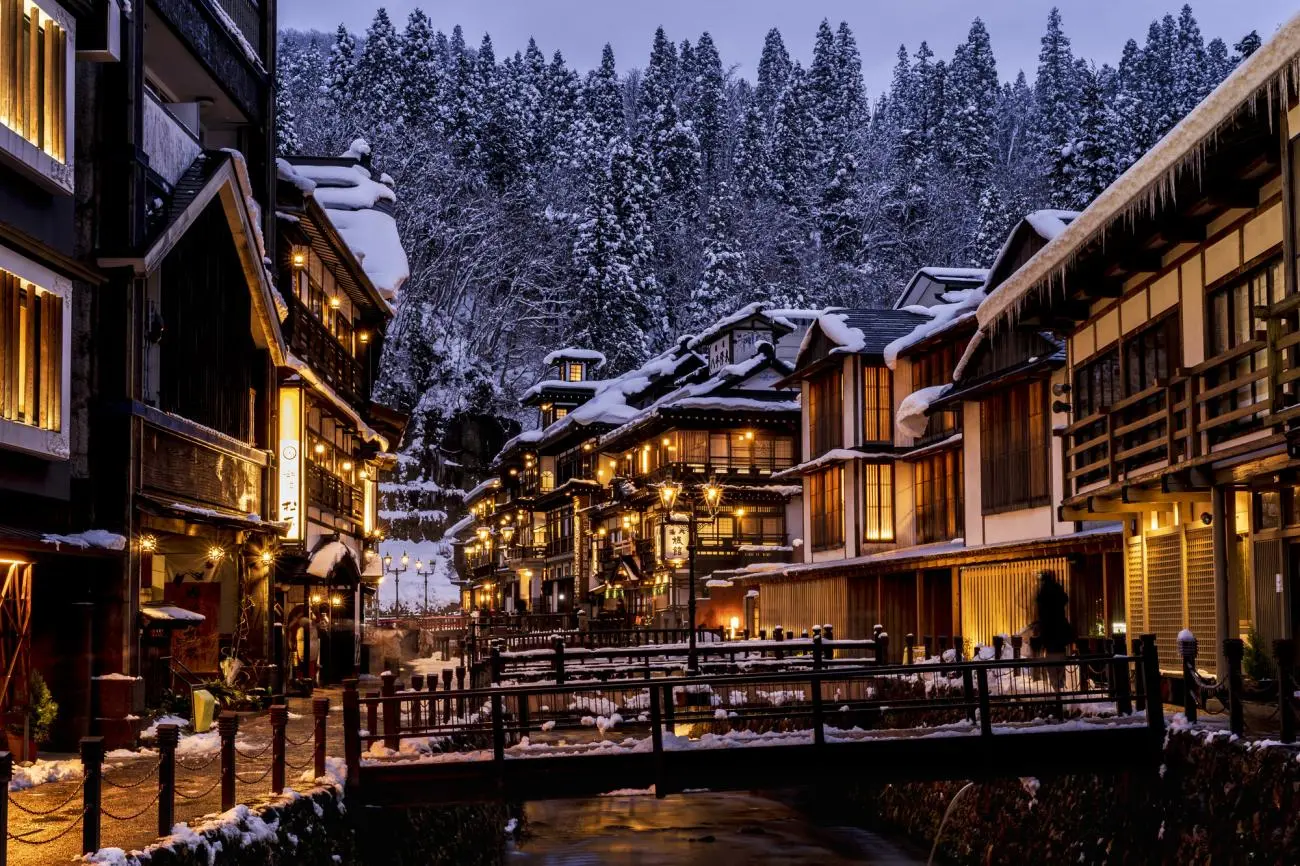
Ginzan means "Silver Mountain." The hot springs here were discovered 500 years ago by miners working the nearby Nobesawa silver mines, and the mining operation at its peak in the early seventeenth century made this area one of the most productive silver-producing regions in the world. When the mines closed in 1689, the town transitioned to thermal tourism, and its modern character was established in the Taisho era (1912–1926) and early Showa period, when the wooden multi-storey ryokans that now line both banks of the Ginzan River were built. There are thirteen ryokans in the town total. The central street is pedestrian-only — no cars, no modern signage, no construction permitted. A local ordinance protects the historic townscape. The result is a street that has not fundamentally changed in a hundred years, which is the specific quality Spirited Away required and which no other onsen town in Japan preserves quite so completely.
After nightfall, gas lamps illuminate the street. In winter, when snow accumulates on the steep multi-storey rooftops and the Ginzan River runs dark between the lit facades, the visual is exactly what every photograph of Ginzan Onsen shows: a warm glow against mountain dark, steam rising, wooden buildings mirrored in the river below. Shirogane-no-Taki waterfall, a 22-foot cascade on the far side of town near the entrance to the old silver mine, is audible before it is visible on quiet nights. The foot bath (warashiyu) at the entrance to the onsen street is free and open to all visitors. The town's entire population is approximately 190 people.
The Facade That Started Everything
Notoya Ryokan's facade is the building that most visitors are looking for when they come to Ginzan Onsen on a Spirited Away pilgrimage, even when they cannot name the specific ryokan. The four-storey wooden structure, with its layered balconies cantilevered over the Ginzan River, its stucco relief panels (鏝絵 — kotemae paintings, images drawn in pigmented plaster by craftsmen, a Taisho-era decorative technique), and its warm light visible from the bridge at the street's entrance, is the building that produces the visual recognition. At night in winter, snow on the roof and gas lamps burning in the street, it looks indistinguishable from the Aburaya seen from a distance in the film. This is not coincidence or coincidental resemblance. Ginzan Onsen's Taisho-era wooden streetscape was the model; Notoya is the building at its center, the one most photographed, the one most reproduced in travel writing about both the town and the film.
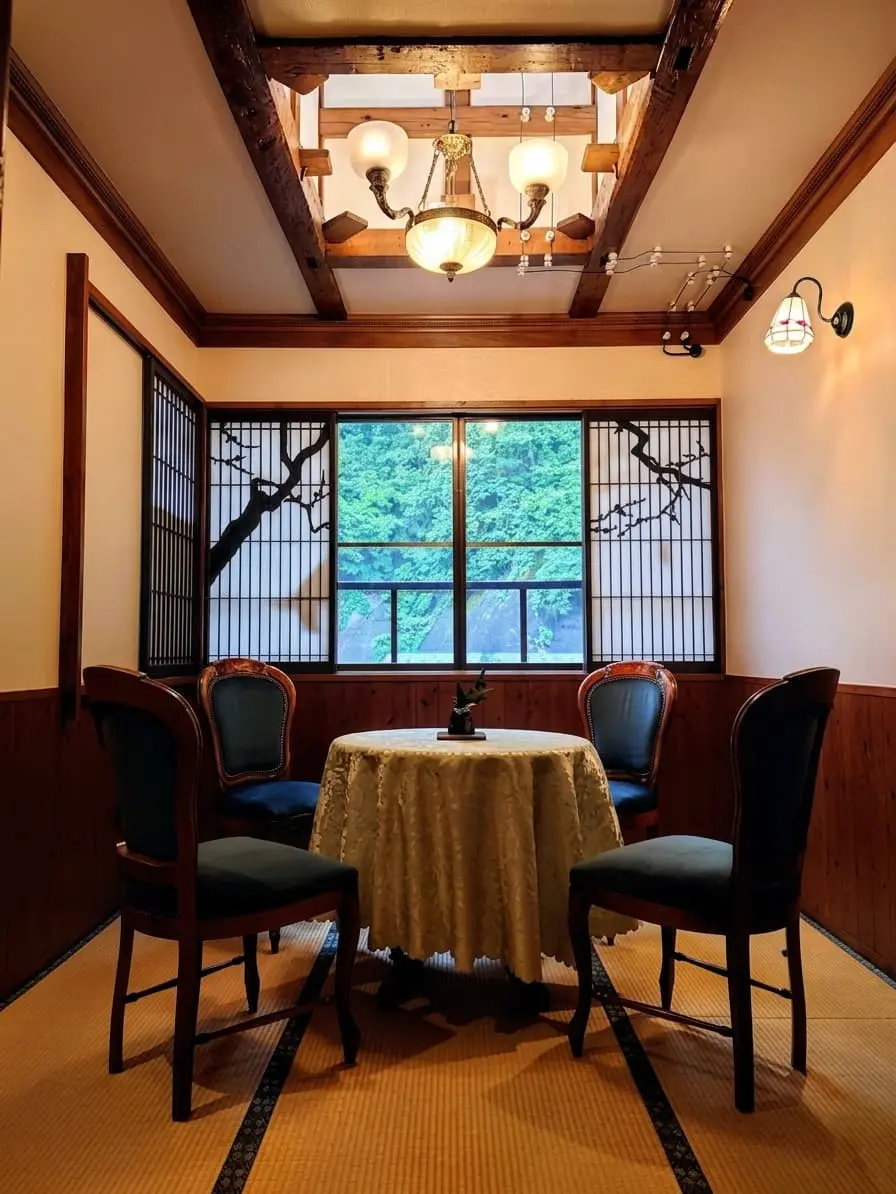
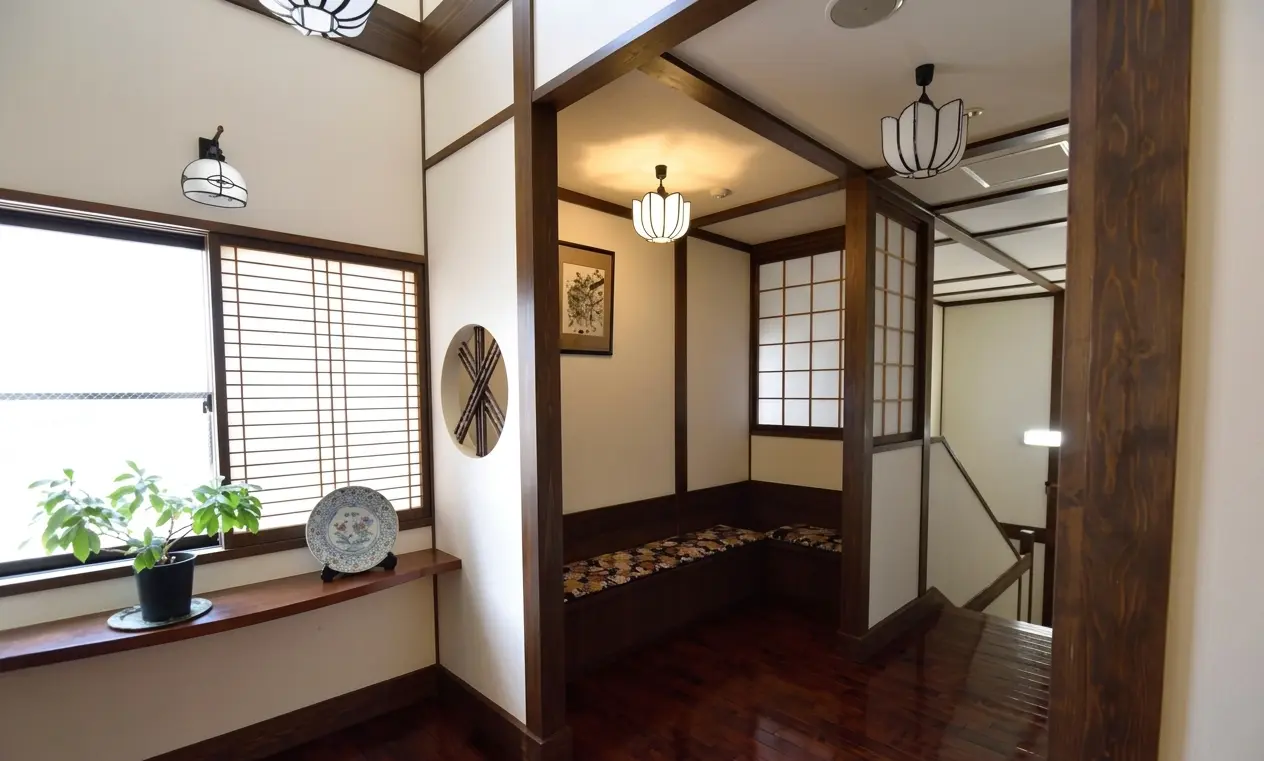
The interior lives up to its exterior in a specific way: the amber-colored wooden staircases, the Taisho-era decorative details applied to corridors and room fittings, the quality of accumulated time visible in the woodwork that no renovation can fully replicate — these are the details that travelers who have visited and written about Notoya consistently mention. The building was renovated in 2010 to maintain its structural integrity while preserving its registered cultural property status, which requires that its essential character remain unchanged. One guest blogger noted that a wooden beam in the annex's ceiling was balanced without a single nail — traditional joinery technique applied to a building that was constructed before nails became the default. The building's national cultural property designation is the reason this detail is still there to observe.
The Hot Springs: Cave Bath, Hilltop Outdoor Bath, Large Communal Bath
Notoya has four distinct bathing areas. The large communal bath (大浴場) in the annex serves guests with separate men's and women's sections. The outdoor bath (露天風呂) provides an open-air option. The hilltop panoramic outdoor bath (展望露天風呂) is accessed by climbing approximately one hundred stairs from the annex; from this elevated position, the view encompasses the Shirogane-no-Taki waterfall and the mountain gorge surrounding the onsen town — the waterfall visible from the bath is one of the specific experiences that guest reviewers mention most frequently. This bath is closed during winter (December to approximately April) due to snow conditions on the access stairs.
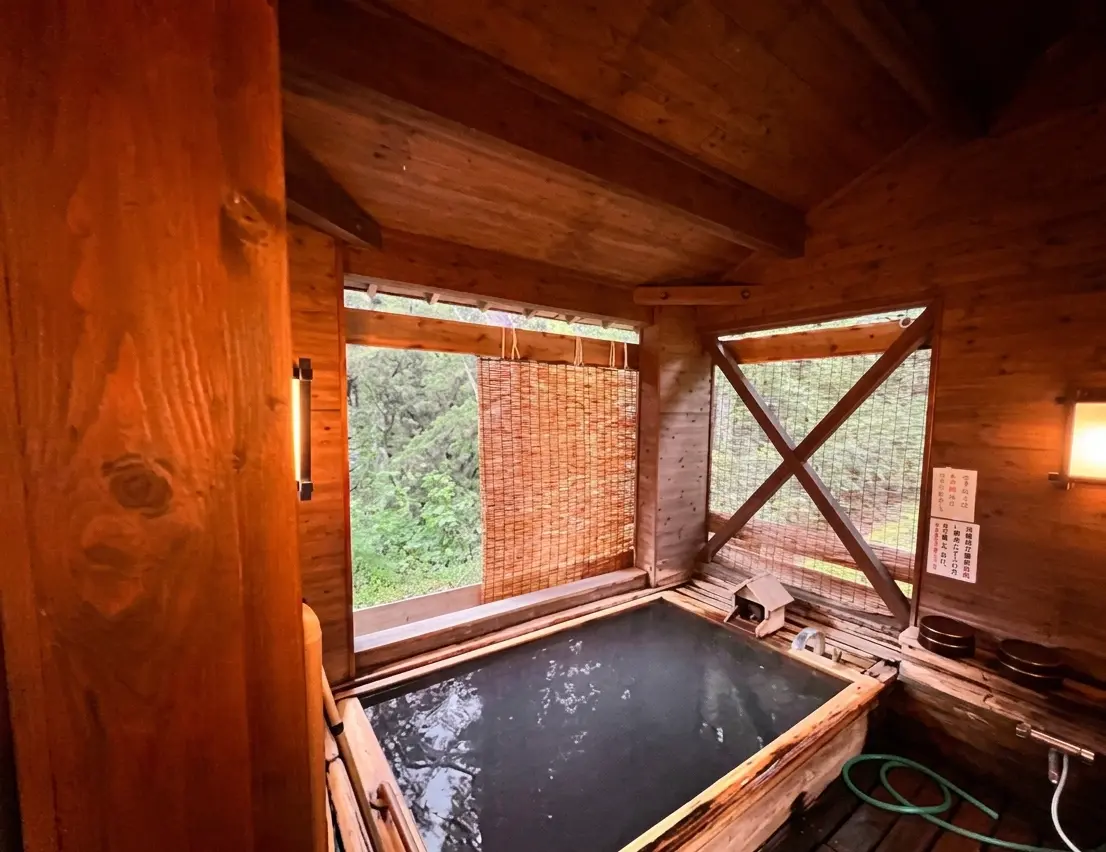
The cave bath (洞窟風呂) is the most historically significant of the four. It has been in continuous use since the ryokan's founding as the original hot spring source — the moto-yu, the originating spring from which the ryokan takes its water. It is currently available as a private-reservation bath, meaning guests can book it for exclusive use by hanging the appropriate sign at the entrance. The spring itself is a sodium chloride and sulfate spring — the mineral composition that Ginzan Onsen produces across its multiple sources — with properties attributed to relieving neuralgia, skin conditions, cold sensitivity, and fatigue. The cave itself adds an atmospheric quality beyond the water: a stone-walled chamber with the specific quality of underground thermal sites, mineral deposits accumulating on the walls, light entering from the entrance only. Soaking in the cave bath at Notoya means soaking in the ryokan's original spring, in the space that has held this function since 1892.
Rooms: Main Building and Annex, River-Facing
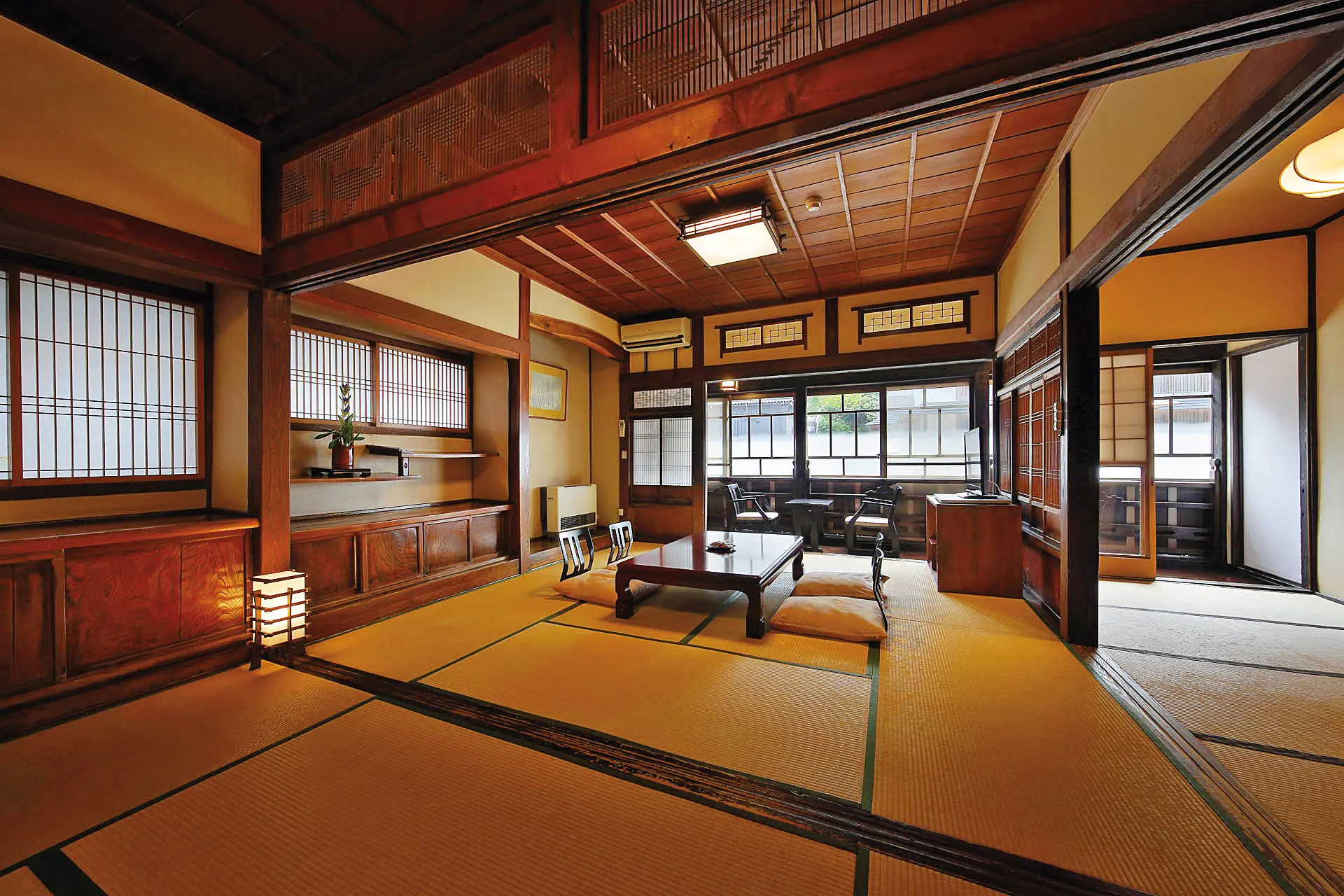
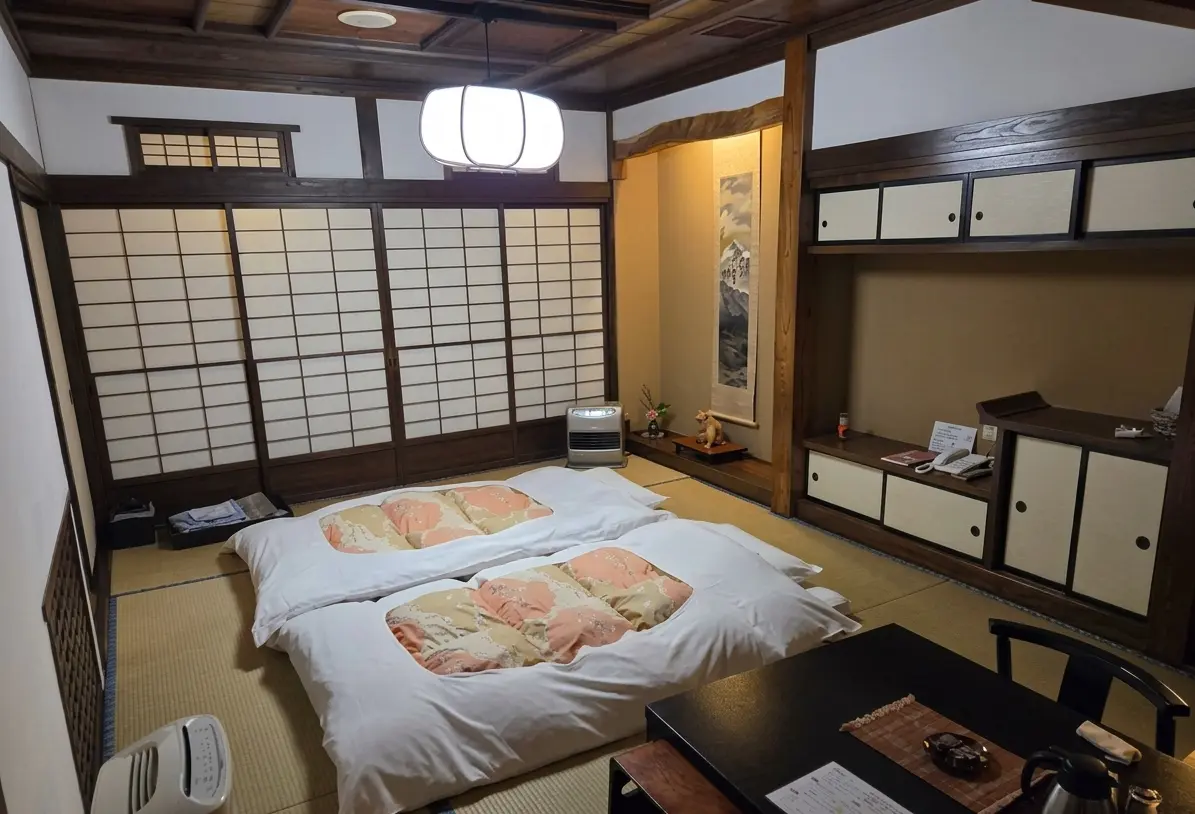
The fifteen guest rooms are distributed between the main building (本館) and the annex (別館), each wing having a different character. Main building rooms offer the most direct connection to the original Taisho-era structure — lower ceilings, aged woodwork, the specific atmosphere of a building that has been inhabited continuously for over a century. Annex rooms, including those renovated in 2010, offer more contemporary comfort within the same overall aesthetic — guests who stayed post-renovation describe the high ceilings, double rows of hanging lights, and joinery details as impressive in a different way from the main building's aged authenticity. River-facing rooms on either side offer views of the gas-lamp street and the opposite ryokan facades; mountain-side rooms offer quieter outlooks toward the gorge. The room assignments cannot be specified by floor or orientation, per the ryokan's own stated policy — request preferences and they will be considered within availability. Each room has a private toilet.
The Café Yamaboshi and the Street
At the entrance to Notoya, beside the main building, the café Yamaboshi (山星) serves tea and light food while guests listen to the Ginzan River from the terrace. The café is open to both hotel guests and day visitors, and its position — at river level, with the onsen street extending in both directions — makes it a useful anchor for a morning or afternoon in the town. The Ginzan Onsen street itself, a short walk in each direction, contains souvenir shops, the public foot bath, two public bathhouses (one of which was designed by architect Kengo Kuma), the entrance to the old mine trail, the bridge photographed for its Spirited Away resemblance, and a costume rental shop for Taisho-era hakama — the style of dress that characterized fashionable visitors to onsen towns during the period when this street was built.
Practical Information
- Check-in: From 14:00 Check-out: By 10:30
- Rooms: 15 rooms — main building + annex · River-facing and mountain-side orientations · All rooms have private toilet · Floor/orientation preference cannot be specified, only requested
- Hot Springs: Large communal bath · Outdoor bath · Hilltop panoramic outdoor bath (closed Dec–Apr) · Cave bath (private reservation, the ryokan's original founding spring)
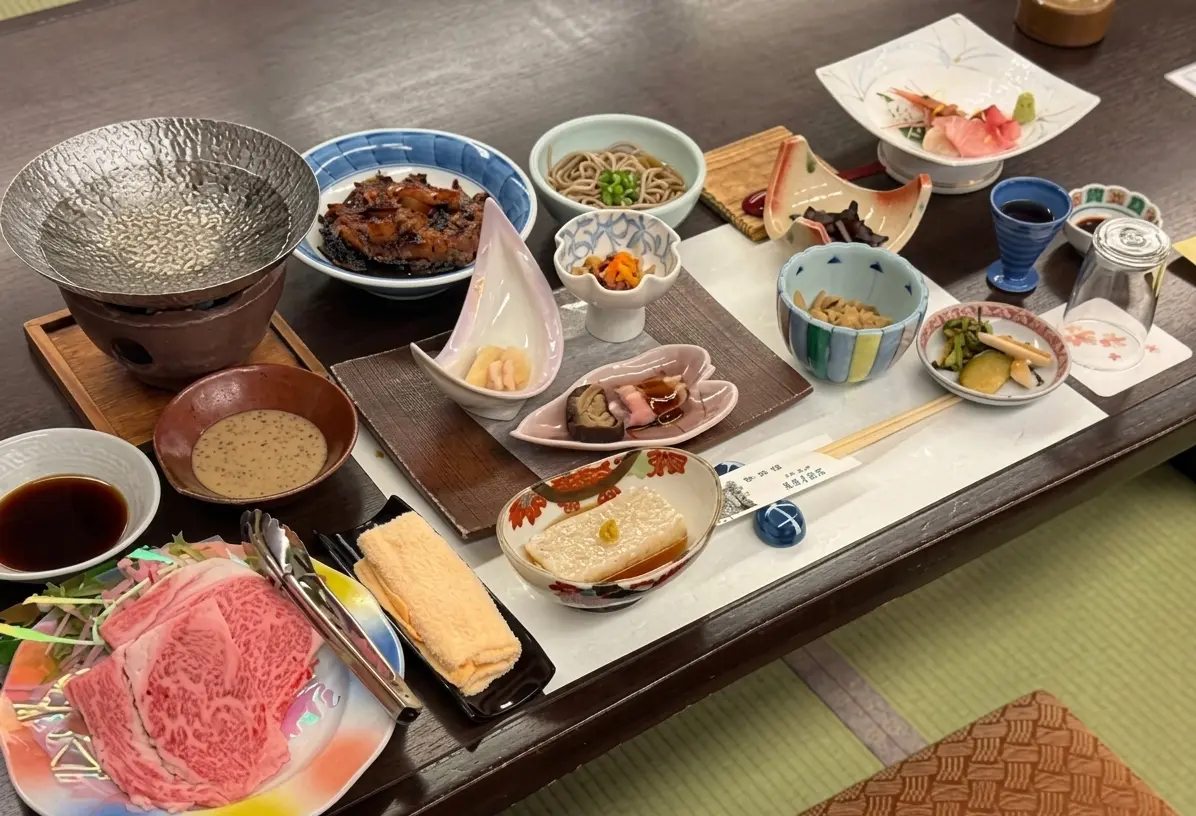
- Meals: Kaiseki dinner and breakfast included · Local Yamagata and Obanazawa specialties — Obanazawa beef (尾花沢牛), carp arai, seasonal mountain produce
- English Reservation: Online booking available in English: reserve.489ban.net/client/notoyaryokan/4/plan/stay · Phone reservations in Japanese only
- From Tokyo: Tohoku Shinkansen to Oishida Station (~2h 20min) → bus or shuttle to Ginzan Onsen (~35–40 min) · Shuttle bus from Oishida departs twice daily; advance reservation required
- From Yamagata Airport: Shared taxi to Ginzan Onsen (~1h 15min)
- By Car: From Tohoku Chuo Expressway Obanazawa IC, ~20 min · Free parking available
- Best Season: Winter (Jan–Mar) for snow-covered facades and gas-lamp atmosphere · Autumn (Oct–Nov) for foliage · Spring for cherry blossom and fresh greenery
- Café Yamaboshi: Open to guests and day visitors at the ryokan entrance · River terrace seating
Getting There: The Shuttle from Oishida
From Tokyo Station, the Tohoku Shinkansen to Oishida Station takes approximately 2 hours 20 minutes. From Oishida, a shuttle bus to Ginzan Onsen takes approximately 35 minutes; Notoya is a 6-minute walk from the Ginzan Onsen bus stop. The shuttle bus departs twice daily from Oishida — departure times should be confirmed with the ryokan at reservation, and advance booking of the shuttle is required. A local bus also operates from Oishida to Ginzan Onsen with five departures daily; check the timetable before travel, as service is infrequent. From Yamagata Airport, a shared taxi service to Ginzan Onsen operates and takes approximately 1 hour 15 minutes. By car from the Tohoku Chuo Expressway, exit at Obanazawa IC and follow Route 347 for approximately 20 minutes; parking at the ryokan is free.
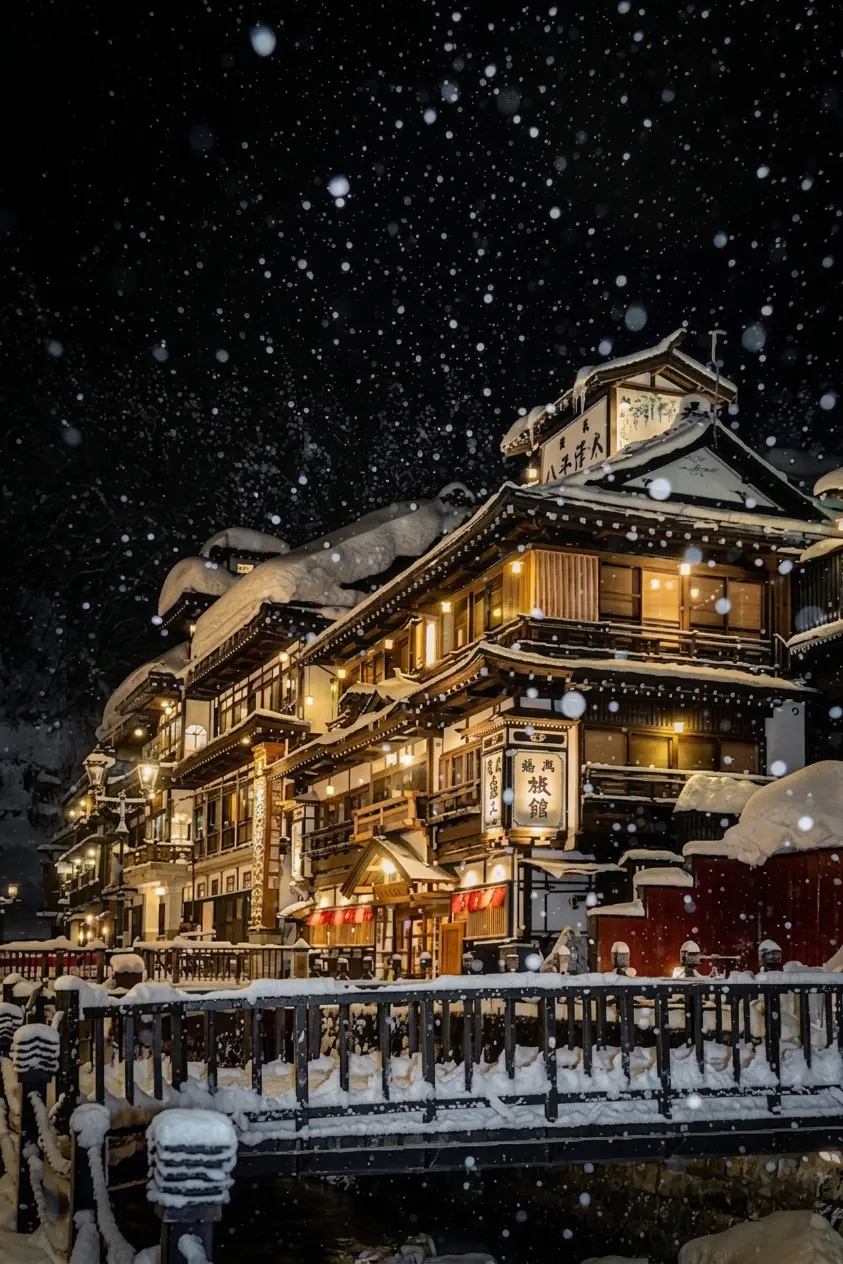
The correct arrival time at Ginzan Onsen is dusk. The bus and shuttle schedules from Oishida can, with planning, produce an arrival in the early evening — the gas lamps come on as the light fails, and checking in while the town transitions from daytime to its evening identity is the specific Spirited Away moment that the pilgrimage exists to produce. An arrival at noon is fine. An arrival at dusk, with the first lamp burning and the river darkening below the ryokan bridge, is the film.
Why This Building, This Street, This Film
Studio Ghibli draws no direct line between Notoya Ryokan and Aburaya. They have not drawn one for any single source — the film assembled its visual world from Dogo Onsen's rooftop silhouette, Sekizenkan's red bridge and underground tunnel, Meguro Gajoen's gilded corridors, Kanaguya's labyrinthine wooden interior, the Edo-Tokyo Open Air Museum's boiler room. The Spirited Away pilgrimage has ten stops because no single building is the bathhouse. It took all of them, and the specific imagination that could see through all of them simultaneously to something that did not exist before the film made it exist.
But Notoya is the building that most people see and recognize first — before the pilgrimage, often before they know what they are looking for. The gas-lit winter facade, reflected in the dark river, with the mountain gorge rising behind it and steam rising from the street: this is the image that circulates, the image that lands in people's memory alongside the film's imagery and does not separate cleanly from it. Staying here means waking up inside the building that produced that recognition — opening the window to hear the river, walking down the amber staircase to the cave bath at six in the morning, stepping out onto the street in yukata while the gas lamps are still burning. The film is somewhere in that sequence. It is not difficult to find.
| Full Name | 銀山温泉 能登屋旅館 (Ginzan Onsen Notoya Ryokan) |
| Address | 446 Ginzan Shinhata, Obanazawa City, Yamagata Prefecture 999-4333 |
| Phone | 0237-28-2327 |
| Anime Connection | Spirited Away — named in Wikipedia's article on the film as an inspiration for Aburaya; JNTO identifies Ginzan Onsen / Notoya in Spirited Away tourism materials; facade is the most widely reproduced visual reference for the film in Ginzan |
| Also Featured In | NHK drama Oshin (1983–84) — confirmed filming location |
| Established | Meiji 25 (1892) · Current Taisho-era building: national registered tangible cultural property |
| Rooms | 15 rooms — main building + annex · All with private toilet |
| Hot Springs | Large communal bath · Outdoor bath · Hilltop panoramic outdoor bath (closed Dec–Apr) · Cave bath (private reservation — founding spring, continuous use since 1892) |
| Spring Type | Sodium chloride + sulfate spring · Skin-smoothing · Effective for neuralgia, fatigue, skin conditions |
| Memberships | Nihon Hiyu wo Mamoru Kai (Society for the Preservation of Japan's Secret Hot Springs) |
| Nearest Station | JR Oishida Station (Tohoku Shinkansen) → shuttle or bus ~35–40 min → Ginzan Onsen · 6-min walk to Notoya |
| Best Season | Winter for snow and gas-lamp atmosphere · Autumn for foliage |
Photo Gallery
Arrive at Dusk. Watch the Lamps Come On.
Book Notoya Ryokan via Trip.com below, or directly through the ryokan's English reservation website.
Notoya is location 10 in our complete Spirited Away pilgrimage — the final stop: Through the Tunnel — Every Real-Life Spirited Away Location in Japan →
Also at Ginzan Onsen: Kosekiya Annex, the oldest continuously operating ryokan in the town and the Demon Slayer Swordsmith Village base: Kosekiya Annex: You Are Standing Inside the Swordsmith Village →
← Back to Stay